
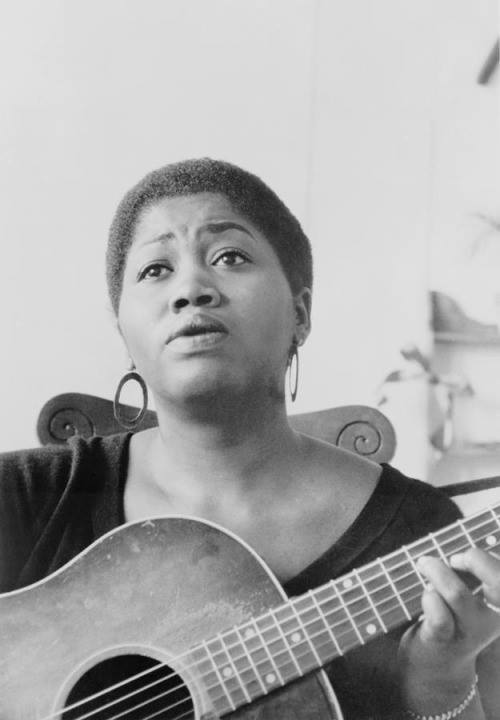
HERStory Matters: Singer-songwriter, actress and activist Odetta was born on December 31, 1930.
Known as “The Voice of the Civil Rights Movement,” Odetta Holmes was
born in Birmingham, Alabama. Before she even learned how to play an
instrument, Odetta banged on the family piano in hopes of making
music—until her family members got headaches and told her to stop.
Growing up in the Deep South during the Great Depression, Odetta fell in love with the work songs she heard people singing to ease the pain of the times.Odetta’s father, Reuben Holmes, died when Odetta was a child. In 1937
she and her mother, Flora Sanders, moved across the country to Los
Angeles. It was on the train to California that Odetta had her first
significant experience with racism. “We were on the train when, at one
point, a conductor came back and said that all the colored people had to
move out of this car and into another one,” she remembered. “That was
my first big wound.”Although Odetta loved singing, she never
considered whether she had any particular vocal talent until one of her
grammar school teachers heard her voice. The teacher insisted to
Odetta’s mother that she sign her up for classical training. In junior
high, after several years of voice coaching, she landed a spot in a
prestigious singing group called the Madrigal Singers. When Odetta
graduated from Belmont High School in Los Angeles, she continued on to
Los Angeles City College to study music. She later insisted, however,
that her real education came from outside the classroom.In
1950, after graduating from college with a degree in music, Odetta
landed a role in the chorus of a traveling production of Finian’s
Rainbow. She fell in love with folk music when, after a show in San
Francisco, she went to a Bohemian coffee shop and experienced a
late-night folk music session. “That night I heard hours and hours of
songs that really touched where I live,” she said. “I borrowed a guitar
and learned three chords, and started to sing at parties.” Later that
year, she left the theater company and took a job singing at a San
Francisco folk club. In 1953, she moved to New York City and soon became
a fixture at Manhattan’s famed Blue Angel nightclub.She
recorded her first solo album, “Odetta Sings Ballads and Blues,” in
1956, and it became an instant classic in American folk music. Odetta
quickly followed with two more highly acclaimed folk albums: “At the
Gate of Horn” (1957) and “My Eyes Have Seen” (1959). In 1960, Odetta
delivered a famed concert at Carnegie Hall and released a live recording
of the performance.The 1960s, however, were Odetta’s most
prolific years. During that decade, she lent her powerful voice to the
cause of black equality—so often so that her music has frequently been
called the “soundtrack of the Civil Rights Movement.” She performed at
political rallies, demonstrations and benefits.In 1963,
during the March on Washington, Odetta gave the most iconic performance
of her life: Singing from the steps of the Lincoln Memorial after an
introduction by Dr. Martin Luther King, Jr. Odetta also recorded more
than a dozen albums during the 1960s, most notably “Odetta and the
Blues,” “One Grain of Sand,” “It’s a Mighty World” and “Odetta Sings
Dylan.”Odetta recorded several more albums over the remaining
four decades of her life. Her most prominent later works include “Movin’
It On” (1987), “Blues Everywhere I Go” (1999) and “Looking for a Home”
(2001). President Bill Clinton presented her with a National Medal of
Arts in 1999. In 2004, she was made a Kennedy Center honoree and in
2005, the Library of Congress awarded her its Living Legend Award. Her
highly acclaimed final album, a live recording performed when she was 74
years old, was entitled “Gonna Let It Shine” (2005).Odetta continued performing right up until almost the day of her death on December 2, 2008, at the age of 77.
Find her catalog of work at http://amzn.to/1OzTRXn.
 Life with Tierra